amicaassist@gmail.com
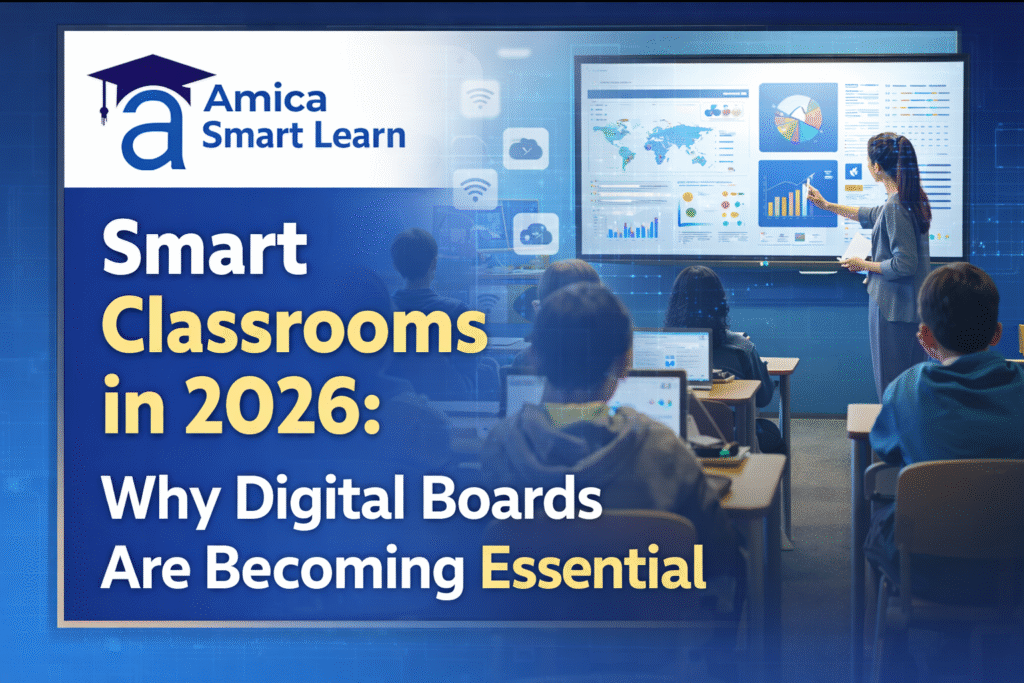
Education is gradually evolving as technology becomes more integrated into everyday learning. Many classrooms that once relied mainly on chalkboards, textbooks, and projectors are now adopting digital tools that support more interactive teaching methods.
This shift has led to the growth of smart classrooms, where traditional teaching is combined with technology such as interactive displays, digital content, and online learning tools. These environments allow teachers to explain concepts using visuals, presentations, and multimedia resources.
Among these tools, digital boards are becoming a central part of modern classrooms. They combine the functions of a whiteboard and a digital display, allowing teachers to write, present, and share lesson materials more efficiently. As schools begin upgrading their classrooms, many work with local setup providers, such as Amica Smart Learn, to help install and configure these systems.
A smart classroom is a learning space that uses digital tools to support teaching and student interaction. Instead of relying only on textbooks and physical boards, teachers can use technology to present lessons in different formats.
Smart classrooms typically combine several tools that work together.
Common components include:
Among these tools, the digital board usually acts as the central hub of the classroom. It allows teachers to manage lessons, display educational materials, and interact with content in real time.
For example, a teacher might display a presentation, draw diagrams over it, play a short video, and then save the annotated notes for students to review later.
This type of setup allows lessons to move smoothly between different formats without requiring multiple devices or complicated equipment.
Many institutions are adopting smart classroom setups because teaching needs have changed. Students often expect learning experiences that combine visual explanations with traditional teaching methods.
Several factors have contributed to this shift.
One reason is the growth of hybrid learning. Some students attend classes in person while others may join remotely. Smart classroom tools allow teachers to manage both groups more easily.
Another factor is student engagement. Visual demonstrations, diagrams, and videos can help students understand complex topics more clearly.
Smart classrooms also allow lessons to be recorded and shared. This is useful for students who want to review material later or who missed a class.
Because these systems involve multiple devices, many institutions work with experienced digital setup providers to implement them correctly.
Digital boards are often the most visible part of a smart classroom. They function as both a display screen and an interactive writing surface.
Teachers can use digital boards in several ways.
They can write or draw directly on the board using touch controls or digital pens. This allows for real-time explanations similar to using a whiteboard.
Digital boards also support video-based learning. Teachers can show educational videos, simulations, or presentations while explaining key concepts.
Another common use is screen sharing. A teacher can display content from a laptop, tablet, or educational platform directly on the board.
Some boards also allow live class recording, which helps students review lessons later.
Because all these features exist in one device, digital boards simplify classroom technology. Teachers can manage most lesson materials from a single interface.
Interactive technology can change how students participate in lessons.
Digital boards allow teachers to present information visually. Diagrams, images, and videos can make explanations easier to follow.
For example, a science teacher explaining the structure of a cell can display a labeled diagram on the board and highlight different parts during the explanation.
Mathematics lessons can also benefit from real-time problem solving. Teachers can write equations on the board, adjust steps, and show alternate solutions.
Recorded lectures are another example. If a student needs to review a concept later, the lesson recording can be revisited.
Interactive lessons can also improve focus. When content changes visually or involves demonstrations, students may find it easier to stay engaged during the class.
Here’s a quick breakdown of the core tech we offer as part of our digital studio builds:
Here’s the best part—we have strong partnerships with top-tier brands, so every piece of tech we install is trusted, tested, and industry-approved. That means you never have to worry about quality or performance—we’ve got it all covered.
And yes, we integrate everything neatly so your studio doesn’t just look good, it works flawlessly, that’s why we are called the Best Digital Studio Setup Company in Dehradun.
Digital boards also change how teachers organize and deliver lessons.
Traditional boards require teachers to rewrite content repeatedly. With digital boards, notes can be saved and reused in future classes.
Teachers can also switch between different types of content quickly. For example, they might move from a diagram to a presentation slide or a short video within seconds.
Digital notes can be saved and shared with students after class. This reduces the need for students to copy everything manually.
Another benefit is support for hybrid classes. If students are joining remotely, the board can display lesson content while the session is streamed online.
Transitioning to these systems sometimes requires proper training. At Amica Smart Learn, we guide teachers through the setup and usage of digital boards so they can feel comfortable and confident using the technology in their classrooms.
Smart classrooms often combine several technologies that support different aspects of teaching.
Some of the most common tools include:
Interactive digital boards
These are the main teaching displays used for writing, presentations, and content sharing.
PTZ cameras
Pan-tilt-zoom cameras allow teachers to conduct live or hybrid classes while capturing the classroom clearly.
Wireless screen sharing
This allows teachers or students to display content from laptops or tablets without cables.
Classroom audio systems
Microphones and speakers help ensure that all students can hear explanations clearly.
Online learning platforms
Digital platforms allow teachers to share assignments, recordings, and learning materials.
When these tools are integrated properly, they create a flexible learning environment where content can be delivered in multiple ways.
Schools planning to adopt smart classroom technology often consider several factors before installation.
One important factor is classroom size. Larger rooms may require larger digital boards or additional audio systems.
Another consideration is board size. The display should be large enough for students at the back of the room to see clearly.
Audio quality is also important. Clear sound helps both in-person and remote students follow the lesson.
Camera placement matters for hybrid classes. Cameras should capture the teacher and the board without obstruction.
Schools should also think about teacher training. Staff members need time to become familiar with the new tools.
Finally, reliable technical support is important. At Amica Smart Learn, we help schools with the installation and configuration of digital classroom systems to ensure everything works smoothly.
Installing digital classroom equipment may seem straightforward, but improper setup can lead to technical problems.
One common issue is incorrect wiring. Poor cable management can cause connectivity problems or unstable performance.
Audio systems may also produce unclear sound if microphones and speakers are not placed correctly.
Camera positioning can affect hybrid classes. If cameras are installed incorrectly, remote students may not see the board or teacher clearly.
Compatibility issues between devices can also occur if the system is not configured properly.
Professional installation helps avoid these problems. Companies that specialize in digital classroom setups typically test the system to ensure that all devices work together correctly.
In Dehradun, many schools and institutes are gradually adopting smart classroom technologies. As classrooms move toward more digital teaching methods, institutions often look for reliable providers who can supply the necessary equipment and help implement it properly.
At Amica Smart Learn, we provide and install digital boards and other technologies used in smart classrooms. This may include integrating digital boards with audio systems, cameras, or other tools that support live or hybrid classes.
By ensuring that these components are properly installed and configured, classrooms can use the technology more effectively. This allows teachers to focus on teaching while the digital systems support presentations, explanations, and recorded lessons when needed.
Smart classroom technology will likely continue evolving in the coming years.
One emerging trend is the use of AI-supported learning tools. These tools can help analyze student performance and provide personalized feedback.
Another development is cloud-based classroom content. Teachers may store lesson materials online so they can be accessed from different locations.
Hybrid education models are also expected to remain common. Students may move between in-person and online learning depending on their needs.
Interactive learning environments will continue to expand as educational software and digital tools improve.
Even as new technologies appear, digital boards are likely to remain a central part of these systems because they combine display, interaction, and content sharing in a single device.
Classrooms are gradually changing as education adapts to new teaching methods and learning expectations.
Digital boards support this shift by allowing teachers to combine traditional explanations with visual and digital content.
They help students understand lessons through diagrams, videos, and interactive examples. Teachers also benefit from features such as saved notes, hybrid class capabilities, and integrated lesson materials.
When these tools are set up properly, they can improve both teaching efficiency and student engagement.
As more institutions move toward smart classroom environments, many choose to work with providers who supply and install the required digital learning tools. In places like Dehradun, Amica Smart Learn supports schools by providing and installing systems such as digital boards and related technologies used in modern classrooms.
What is a smart classroom?
A smart classroom is a learning space that uses digital tools such as interactive boards, cameras, and online platforms to support teaching and improve student interaction.
Are digital boards necessary for modern schools?
Digital boards are not mandatory, but they can help teachers present lessons visually and manage digital content more easily.
How much does a digital classroom setup cost?
Costs vary depending on equipment, classroom size, and installation requirements.
Can digital boards be used for hybrid classes?
Yes. Digital boards can display lesson content while the session is recorded or streamed to remote students.
What size digital board is best for classrooms?
The ideal size depends on the classroom layout and number of students. Larger rooms usually require larger displays for clear visibility.