
Angesh Shukla’s Digital Studio with 2 Podcast Setup in Gorakhpur
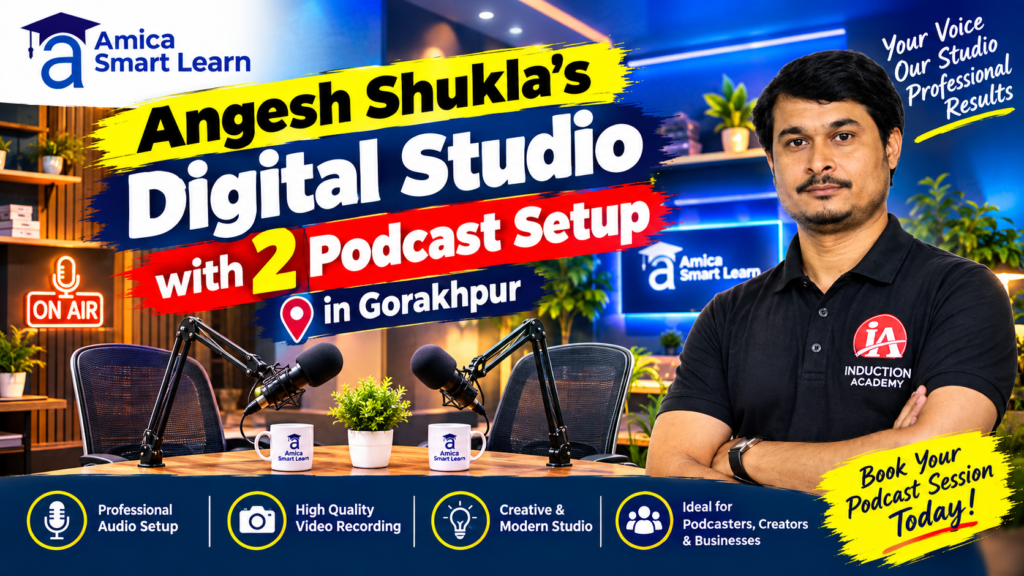
Gorakhpur is quickly becoming one of eastern Uttar Pradesh’s most active content-creation hubs, and creators like Angesh Shukla are leading that shift. Rather than settling for a single-room, single-purpose setup, Angesh chose to build two fully equipped podcast and recording studios under one roof — a decision that lets him run parallel productions, host multiple creators, or separate teaching content from podcast content without ever double-booking a room. This guide walks through Angesh Shukla’s complete twin digital studio and podcast setup in Gorakhpur, covering the equipment, the reasoning behind a dual-studio layout, the installation process, and why this kind of setup is becoming the new standard for serious creators in the region.
Why Gorakhpur Creators Are Investing in Studio Infrastructure
Gorakhpur’s digital economy — from coaching institutes to YouTube educators to independent podcasters — has grown well beyond what a smartphone and a ring light can support. Audiences now expect broadcast-style visuals, clean multi-mic audio, and consistent lighting, and brands increasingly vet creators on production quality before signing sponsorship deals. A purpose-built studio removes the guesswork and the constant scramble to rent space in Lucknow or Varanasi.
What makes Angesh Shukla’s setup distinct is the duplication: two nearly identical, fully functioning podcast rooms, each with its own display, camera, microphone, computer, and lighting rig. This isn’t a backup room — it’s a second production line, built for creators who need to keep content flowing without interruption.
Complete Equipment Breakdown: Two Studios, One Ecosystem
The table below outlines the core components installed across both studio rooms in Angesh Shukla’s setup:
| Component | Specification | Role in the Studio |
|---|---|---|
| Smart Display Panels (x2) | Evota 75-inch Android, 8GB RAM, 128GB storage | Central presentation screen and visual backdrop for each studio |
| 4K PTZ Cameras (x2) | Evota AI-enabled, motorized pan-tilt-zoom | Automated multi-angle capture, one per room |
| Wireless Microphone Systems (x2) | Hollyland dual-band | Cordless, interference-free audio for hosts and guests |
| Studio Lighting | 20 x 36-watt panel lights (10 per room) | Even, shadow-free illumination across both sets |
| Wall Mount Stands (x2) | Heavy-duty display mounts | Secure, space-saving panel installation |
| Recording & Editing PCs (x2) | Intel i5 11th Gen, 8GB RAM, 512GB SSD, dedicated 2GB graphics | Video capture, live streaming, and post-production per room |
| Secondary Monitors (x2) | 22-inch TFT displays | Live preview, audio monitoring, and editing reference |
| Professional Setup & Installation | Full technical commissioning, per room | Calibration, networking, and end-to-end testing |
Every component was installed in duplicate, giving Angesh Shukla two mirrored production environments rather than a single studio with backup parts sitting idle.
The Logic Behind a Two-Room Podcast Setup
Most creators start with a single studio and quickly hit a scheduling wall — one guest recording, one course shoot, one live stream at a time. Angesh Shukla’s twin setup solves this from day one:
- Parallel production: One room can host a live podcast recording while the other handles a course shoot or client project.
- Zero downtime for maintenance: If one room needs a lighting adjustment or camera recalibration, production simply continues in the second studio.
- Team scalability: Two independent rooms mean Angesh can bring on a co-host, guest producer, or second creator without either party waiting for studio access.
- Consistent branding across rooms: Because both spaces use identical Evota displays, PTZ cameras, and lighting, content shot in either room looks and sounds the same to the audience.
Evota 75-Inch Android Displays: The Visual Anchor of Each Room
Each studio is built around a 75-inch Evota Android smart display running on 8GB RAM with 128GB of internal storage. These panels do double duty — they act as the on-screen backdrop during recordings and as a live control surface for slides, streaming dashboards, or teaching material. The Android operating system means each display runs presentation apps, streaming software, and content management tools natively, without needing an external device plugged in for basic operations.
AI-Powered 4K PTZ Cameras in Both Rooms
Each studio is fitted with an Evota 4K PTZ camera featuring AI-assisted tracking. For a solo creator like Angesh — or any guest recording without a dedicated camera operator — this is the feature that changes everything. The camera automatically follows the presenter’s movement, keeping framing tight and professional throughout a recording, whether it’s a solo podcast episode, an interview, or a lecture-style video.
Because both rooms carry the same camera model, footage from either studio can be cut together without any visible mismatch in color, resolution, or motion quality.
Hollyland Dual-Band Wireless Audio
Clean audio is what separates a podcast people finish listening to from one they abandon after two minutes. The Hollyland dual-band wireless microphone systems installed in both rooms operate across multiple frequency bands, keeping recordings free of interference even with two studios and multiple wireless devices running simultaneously in the same building. For podcast production, this setup supports:
- Guest interviews without tangled cable runs
- Natural, hands-free movement for hosts
- Stable dual-band frequency switching if interference is detected
- Simultaneous recording in both rooms without cross-signal issues
Studio Lighting: 20 Panel Lights Across Two Rooms
With ten 36-watt panel lights installed in each studio, Angesh Shukla’s setup achieves even, professional illumination that eliminates harsh shadows and unflattering skin tones on camera. Distributing the lighting evenly across both rooms ensures neither studio is treated as the “secondary” space — both are built to full broadcast standard.
Dual Recording PCs: Independent Processing Power Per Room
Rather than sharing one computer across two studios, each room has its own dedicated recording PC — an Intel i5 11th Gen machine with 8GB RAM, a 512GB SSD, and a 2GB dedicated graphics card. This means video encoding, live-stream processing, and multi-track audio recording in one room never competes for processing power with activity in the other. Each PC is paired with its own 22-inch TFT monitor for real-time preview, audio level monitoring, and basic editing work on-site.
How This Twin Setup Serves Different Content Needs
Podcast Production: Both rooms are fully podcast-ready — wireless audio, AI camera tracking, and consistent lighting mean Angesh can record a solo episode in one room while a guest interview is being set up in the other.
Educational Content: The large Evota displays make each room suitable for recording structured lessons or course material, with the PTZ camera automatically adjusting as the presenter moves between the screen and the desk.
Corporate and Client Work: Having two independent rooms allows Angesh to take on client production work — filming a company’s training video in one studio without disrupting his own podcast schedule in the other.
Live Streaming: Each recording PC is capable of independent live streaming, meaning both rooms could theoretically go live at the same time for different platforms or audiences.
Installation Process: Building Two Studios in Parallel
Setting up a twin-room studio requires careful sequencing to keep both spaces consistent:
Phase 1 — Room Preparation Both spaces are assessed for layout, power access, and acoustic considerations before any equipment arrives.
Phase 2 — Display and Wall Mount Installation The Evota 75-inch panels are mounted and calibrated in each room using the heavy-duty wall stands, ensuring identical viewing height and angle across both studios.
Phase 3 — Camera and Audio Setup The 4K PTZ cameras are positioned and range-tested in each room, followed by pairing and frequency testing of the Hollyland wireless microphone systems.
Phase 4 — Lighting Configuration Ten panel lights per room are positioned to eliminate shadows and balanced for consistent color temperature across both studios.
Phase 5 — Computer Integration and Testing Each recording PC is networked, paired with its TFT monitor, and stress-tested alongside its camera and microphone system to confirm smooth simultaneous operation.
Phase 6 — Full System Commissioning Both rooms undergo complete end-to-end recording and streaming tests before final handover, ensuring Angesh can start producing content in either studio immediately.
Why a Professional Twin Setup Outperforms a Single DIY Room
- Redundancy: A single-room DIY setup has no fallback if equipment needs servicing. Two professionally built rooms mean production never fully stops.
- Consistency: Matching equipment across both rooms keeps the visual and audio identity of the content uniform, regardless of which room a video was shot in.
- Capacity: Two studios can support a growing team, guest creators, or client projects without a single bottleneck room.
- Professional Credibility: A multi-room facility signals a level of seriousness that helps attract sponsors, collaborators, and institutional clients.
Choosing the Right Installation Partner for a Multi-Room Studio
Building two synchronized studios is more complex than a single-room install, so the installation partner matters:
- Equipment Authenticity: Every camera, mic, and display across both rooms should be genuine and matched in spec, not mixed batches of varying quality.
- Cross-Room Technical Integration: The provider needs to understand how to keep both rooms independently functional while maintaining consistent calibration between them.
- Post-Installation Support: With double the equipment, having reliable warranty and maintenance support becomes even more important.
- Training for Multi-Room Operation: Angesh’s team needs to be comfortable operating both rooms independently, including basic troubleshooting in each.
Conclusion: A Scalable Content Engine in Gorakhpur
Angesh Shukla’s twin digital studio and podcast setup in Gorakhpur reflects where serious content creation is heading — not a single improvised corner, but a scalable, duplicated production environment built to handle podcasts, courses, live streams, and client work simultaneously. With matched Evota displays, AI-tracking 4K cameras, Hollyland wireless audio, dedicated recording PCs, and professional lighting in both rooms, this setup gives Angesh the infrastructure to grow his content output without being limited by a single room’s availability.
 Call us at +91 9125161262
  Email: amicaassist@gmail.com
  Visit us at Roopa Tower, Aman Vihar, Sahastradhara Road, Dehradun
  Visit Our Website – Amica Smart Learn
Frequently Asked Questions
1. Why build two studio rooms instead of one larger studio?
Two independent rooms allow parallel production — recording in one room while the other is used for a different project — rather than one large space that can still only host one shoot at a time.
2. Can both rooms live stream at the same time?
Yes. Since each room has its own dedicated recording PC, both studios can independently record, edit, or stream at the same time without affecting each other’s performance.
3. Do both studios need to be operated by different people?
Not necessarily. A solo creator can alternate between rooms for different content types, while a growing team can use both rooms simultaneously as more people join the production process.
4. How is audio kept separate between two active studios in the same building?
The Hollyland dual-band wireless microphone systems operate on separate frequency channels in each room, preventing crosstalk or interference even when both studios are recording at once.