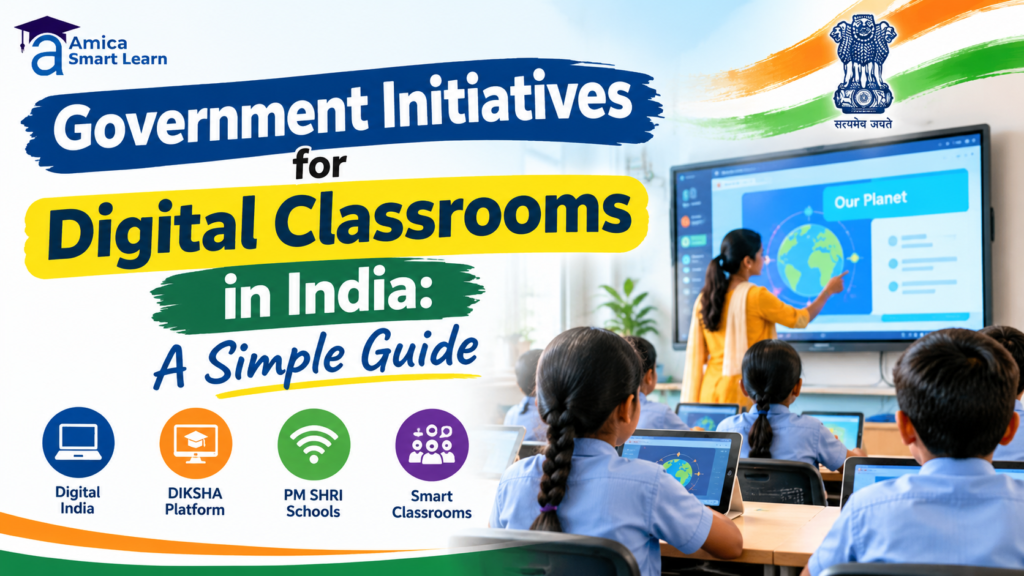
Government initiatives for digital classrooms in India are programmes run mainly by the Ministry of Education to bring technology, online content and internet access into schools. The key ones are NEP 2020, PM eVidya, DIKSHA, SWAYAM and the ICT component of Samagra Shiksha.
India is promoting digital classrooms to give every child, in a city or a remote village, equal access to quality learning material. Technology also helps teachers explain topics with videos, images and activities instead of only chalk and talk.
The main reasons behind this push are:
These goals connect directly to smart classrooms, digital boards and e-learning platforms that schools are adopting today.
The National Education Policy (NEP) 2020 supports the use of technology at every level of education, from early years to higher studies. It has a dedicated section on digital and online education, and it is the base for most digital learning schemes in India.
Key digital points in NEP 2020:
In short, NEP 2020 treats technology as a support for teachers, not a replacement for them. You can read the full policy on the Ministry of Education website.
PM eVidya is a Ministry of Education programme, announced in 2020 under the Atmanirbhar Bharat Abhiyaan, that brings all digital education efforts together in one framework. Its main idea is “multi-mode access”, which means students can learn through different channels based on what they have at home.
PM eVidya matters because it does not depend only on the internet. A child with a TV or radio can still learn, which makes digital education more inclusive.
DIKSHA (Digital Infrastructure for Knowledge Sharing) is India’s national digital platform for school education, launched in 2017. It offers free e-content, quizzes and QR-coded “energised textbooks” for all grades.
DIKSHA works well with digital boards because teachers can open videos and activities on a large screen for the whole class. You can explore it on the official DIKSHA portal.
Samagra Shiksha is the Government of India’s main school education scheme, and its ICT and Digital Initiatives component supports smart classrooms and computer labs in government and aided schools for classes VI to XII. It is the scheme most closely linked to classroom hardware.
What this support usually covers:
States and Union Territories plan and implement these projects according to their needs. This is why digital classroom progress can look different from one state to another.
SWAYAM is the government’s free online course platform, and SWAYAM Prabha is a set of DTH channels that broadcast educational content around the clock. Both support learners beyond the school classroom.
SWAYAM, short for “Study Webs of Active-Learning for Young Aspiring Minds”, offers free courses from school to higher education level. Learners can study at their own pace. Visit the official SWAYAM portal to see available courses.
These DTH channels deliver lectures through TV, helping students who have limited internet access.
Other Useful Platforms
Digital classrooms work only when teachers are trained and schools are connected. The government supports both through teacher training programmes and rural connectivity projects.
Together, these steps help teachers feel confident with technology and keep students safe online.
The table below shows the main digital education initiatives in India side by side.
| Initiative | Main Purpose | Who Benefits | Mode of Access |
|---|---|---|---|
| NEP 2020 | Policy direction for digital and online education | Students, teachers, schools | Policy framework |
| PM eVidya | Unify digital learning efforts | School students | Internet, TV, radio, podcasts |
| DIKSHA | Free e-content and QR-coded textbooks | Students and teachers | App and website |
| Samagra Shiksha (ICT) | Smart classrooms and ICT labs | Government and aided schools, classes VI to XII | Hardware and software support |
| SWAYAM | Free online courses | School, college and adult learners | Website and app |
| SWAYAM Prabha | Educational TV lectures | Learners with low internet access | DTH channels |
| NISHTHA | Teacher training | School teachers | Online and in-person |
| Initiative | Type | Main Purpose | Digital Classroom Relevance |
|---|---|---|---|
| NEP 2020 | National policy | Guides education reform | Supports technology use, digital content, and blended learning |
| Samagra Shiksha | Centrally sponsored scheme | Supports school education | Provides approved support for ICT labs and smart classrooms |
| PM SHRI | Model-school scheme | Develops exemplar schools | Includes smart classrooms, digital resources, and modern labs |
| DIKSHA | National digital platform | Provides curriculum-linked resources | Gives teachers and students online and offline content |
| PM eVIDYA | Multimode initiative | Expands access to learning | Uses digital platforms, TV, radio, and accessible content |
| NIPUN Bharat | National mission | Advances foundational literacy and numeracy | Guides digital support for children in the foundational stage |
| BharatNet | Connectivity programme | Expands rural broadband | Supports connected learning in rural government schools |
| NISHTHA | Teacher-development programme | Builds teacher and school-leader skills | Supports digital pedagogy and educational technology training |
Schools can benefit by pairing free government content with the right classroom technology and trained teachers. A digital board makes this easy because content from DIKSHA, SWAYAM and other sources can be shown clearly to the whole class.
Simple steps to follow:
To see how a smart classroom setup can fit your school, explore the solutions on Amica Smart Learn.
Government initiatives for digital classrooms in India are making quality education more accessible through policy, free content, teacher training and school infrastructure. Schools that combine these resources with modern teaching tools, such as digital boards, can create engaging classrooms that prepare students for the future.